
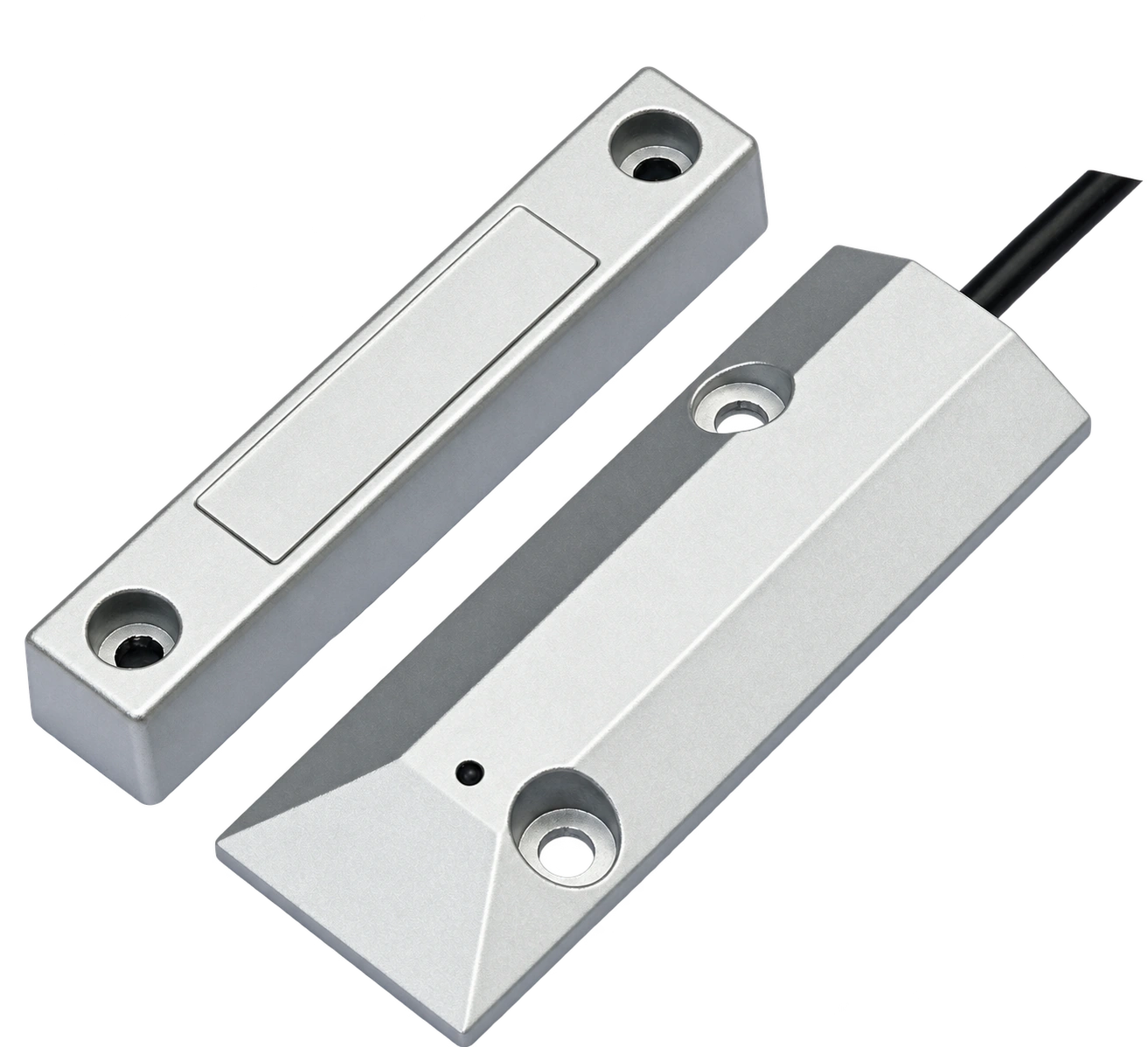
Hall-Effect Door Sensor
A wired magnetic door sensor with non-contact Hall sensing and logic-level output for compatible vehicle equipment, available in unipolar and omnipolar versions
Discuss this modelKey features
- Non-contact magnetic detection converts door or object movement into an electrical switching signal.
- Choose a unipolar version triggered by the S pole, or an omnipolar version triggered by either S or N.
- Logic-level output through a cable for connection to compatible vehicle data-acquisition equipment.
Functions in detail
Choose the magnetic sensing version
- Unipolar: S-pole activation, 4.5–24 V operating voltage and 50 kHz operating frequency.
- Omnipolar: activation by S or N, 2.4–26 V operating voltage and 15 kHz operating frequency.
- The variants have different output-current and typical operating-point values; select them as separate configurations.
Door-state signal acquisition
- Magnetic activation works without physical contact between the sensing parts.
- The output is an electrical level signal; match the receiving input to the chosen version.
- The cable connection is intended for compatible vehicle equipment to collect state signals.
Technical specifications
| Parameter | Specification |
|---|---|
| Operating voltage | Unipolar: 4.5–24 V; omnipolar: 2.4–26 V |
| Operating frequency | Unipolar: 50 kHz; omnipolar: 15 kHz |
| Output current | Unipolar: 20 mA; omnipolar: 3–26 mA |
| Typical operating point | Unipolar: 170GS; omnipolar: 20GS |
| Operating temperature | Unipolar: -10°C to +80°C; omnipolar: -10°C to +80°C |
| Triggering magnetic pole | Unipolar: S pole; omnipolar: either S or N pole |
Installation and configuration
Choose the unipolar or omnipolar version, then check its supply voltage, output current and compatibility with the receiving input. Confirm the magnet orientation and signal changes as the door opens and closes. Check the wiring and triggering distance for the actual product configuration.